AR Glasses
Anyone who's followed this space remembers the Google Glass introduction back in 2014. If you don't, that's because it was a magnificent failure. The product was just way too early and goofy-looking. Its greatest feat was becoming the target of a classic SNL skit.

The more successful path was the Oculus -> Facebook/Meta path. While initially focused on Virtual Reality (like strapping a little TV set to your face), hard work and a few technical cycles have gotten us to the point that AR glasses are almost, kind of, a thing.

Well not really. Meta made a thousand of these in mid-2024, but they would cost way too much to release. It amounted to a statement that the window of feasibility is opening. With a couple more turns of the magic technology crank it will be the cool gadget in the late 2020s. But what is it *for*?

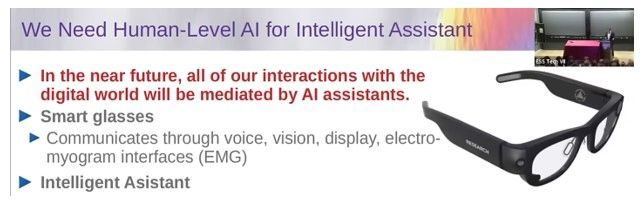
First up will be location services. The glasses know where you are and can see and hear what you see. The context this provides is enormous. And there will be ads, of course. But the big one, as Yann LeCun (Meta's AI lead) points out, is a personal assistant "living in the glasses"
Not the fully formed Twins described in the book, but we are undoubtedly on that path. Meta have been explicit that they don't believe humans will interact with the internet the way we do for much longer.
Google will stop being a verb and be something you have to explain to your kids.
Parent: When I was young, we had to search the internet.
Kid: Huh?
Parent: Yeah, you'd have to guess how someone might have written about what you're interested in, then ask the question, skip past a mess of stupid ads, then start clicking on links, hoping you could find the answer to your question written there.
Kid: Why not just ask?
Parent: That's how we asked.
Once you have a free-flowing interruptible voice interface that's always with you, why would you pull out a phone and thumb away? Except for privacy and discretion, we'll come back to that.
Think about it this way: you search the web dozens (hundreds?) of times a week. Some are quick hitters, some are a chain of simple-ish questions, and a few need a serious sit-down and lots of browser tabs. One use case after another will flip over to that voice interface in your glasses who knows where you are, what you're looking at, and, eventually, you. The better it knows you, the better it can fill in your question from context.
And context is king. Not just knowing where you are, what's on your calendar, and what you're looking at. But also, what you feel about what you see (curious, angry, happy, confused, ...), and what you felt and thought about it last week and the week before. The minute this AI and you share a history, then you have an assistant. Sooner or later that's an advisor, personal shopper, therapist, coach, and friend.
When you have a personal AI who knows your likes and dislikes, your history, what you mean even when you aren't clear, and who was, quite literally, fed the internet as a baby, well ... are you going to ask your digital doppelgänger or Google? Are you gonna pull your iPhone 23 out of your pocket and thumb a question at it, or are you gonna whisper "is that restaurant as good as it looks?" to your personal AI who knows what you thought of the last dozen places you ate at? I know my answer.
And there it is. Your personal AI will increasingly feed you your information diet. Heck of an advertising platform huh? But the information flows both ways. Your interactions with the AI and the world, will be the highest quality source of new data with which to train further upgraded AIs, "all the way to AGI" as Stash says. And beyond.
And that's why Big Tech will fight tooth and nail to control this platform. It's why governments will ultimately prevent the hardware vendor from being the AI vendor, etc., etc. It's why Zuckerberg is full steam ahead on "Open Source AI" and "AR Glasses" while he says he's dialing back the Metaverse investment. Google didn't let the failure of Glass derail them, instead they plugged away and recently introduced Android XR—the extension of Android for glasses. Meanwhile Apple introduced the Vision Pro to market at an uncharacteristically prototype level to prime the developer ecosystem.
Who's gonna win? More than one, for sure. Right now, while I'm no Facebook fan, I think Meta has it exactly right: the glasses fit as much processing as they can, and link with a phone-sized gadget that you're used to carrying around anyway. Maybe it's a phone to start, but more likely you dispense with the cost and power draw of that big pretty display because you have a pair on your face that appears to be the size of a 69-inch TV. So that phone becomes a solid brick, crammed with AI processing and communications, offloading the glasses.
So ... when? These things are in the early prototype stage now. In a year or two, they'll be at the early adopter stage, and a couple of years later, before the end of the decade, they'll be reaching mass adoption.
Further Reading:
- A fun ad for a Kickstarter campaign pair of glasses here.
- Foxconn, the contract manufacturer of iPhones and other consumer products is gearing up its supply chain for AR glasses here.
- For a deeper read, checkout this white paper.